
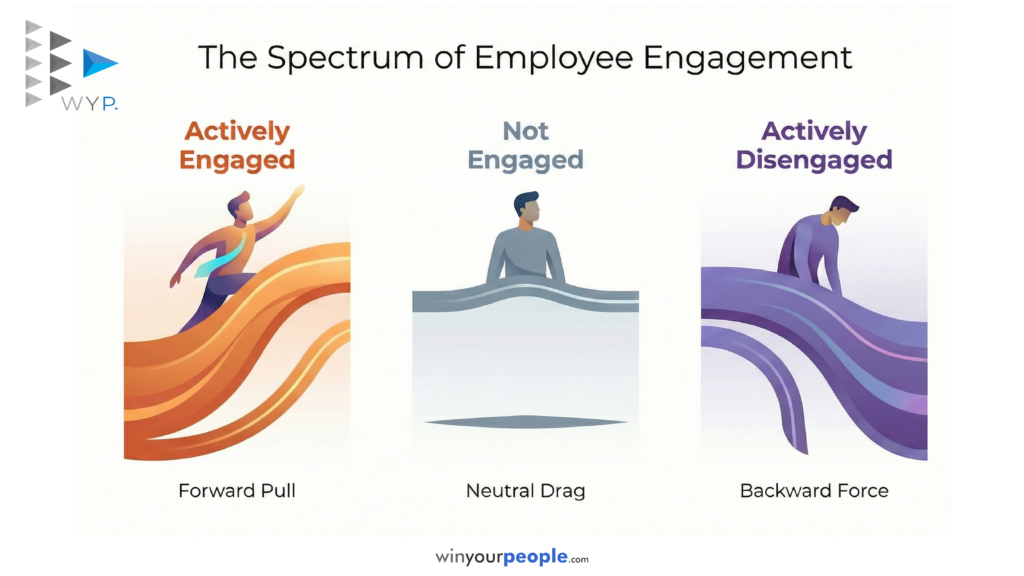
Employee engagement has been the talk of HR town since I can remember. It’s Bigfoot, the one some people claim to have seen but everyone wants to see.
Today’s post is an attempt to find this mysterious creature and capture it to get results – predictably.
What is Employee Engagement?
What do I mean by ‘employee engagement’?
Here’s the simplest definition I’ve found so far:
So, as a manager, which kind of people do you want on your team? Is it even a question?
That’s why I’ve chosen to discuss this topic based on credible research and not by dishing out my grand opinions.
The brain behind this study, Puneet Kumar, dived deep into the sea of engagement research before giving us this V-5 Model of Employee Engagement.
Main Idea
Puneet Kumar has developed a model of employee engagement, called the V-5 model of Employee Engagement, which is specifically relevant in today’s frenzied world of work that resembles a mosh pit.
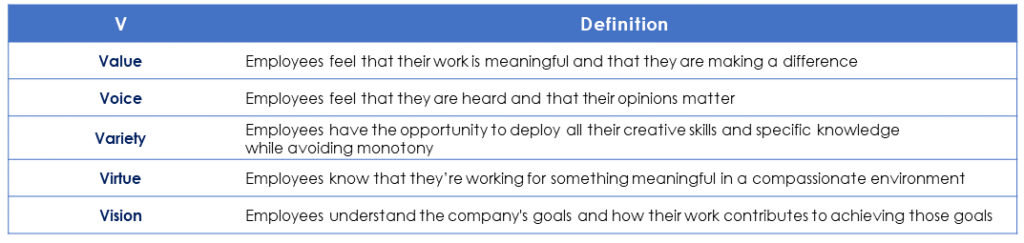
This employee engagement model is called V-5 because it is based on five key elements: Values, Voice, Variety, Virtue, and Vision.
Why V-5 Model of Employee Engagement?
If I could have one engagement model for breakfast every morning, there would be enough to last me for my lifetime. So why did I choose to share this model?
(No, the author doesn’t have an affiliate program)
I’m talking about this one because:
1. The five ways to win employee engagement given in this model don’t require you to get a second mortgage. It costs nothing on your part, but it does require some serious thought and attention.
2. This model of employee engagement takes care of both the employees and the organization.
2. This engagement model is more relevant to today’s world because the author has focused on the changes that the pandemic has brought.
What are the 5 Vs of Employee Engagement?
It’s time we looked at all 5 Vs.
How to Ensure All 5 Vs in Your Team?
If you’re wondering what exactly you, as a manager, can do to enhance your team’s engagement levels, here are practical tips for embedding all 5 values in your team:
V-1: Value
- Create opportunities for them to use their skills and talents. This could involve giving them more challenging projects or allowing them to work on areas that they are passionate about.
- Interact with them regularly. Being too busy is a leadership trait from the past century. Stay in touch with your team and be always available for them.
- Show appreciation for employees’ contributions. It doesn’t have to be a paid vacation every time. Appreciation is a mindset that you need to have for your people. Grab every chance to recognize their efforts, even if it’s in the shape of a few words.
V-2: Voice
- Support. Be a manager who is approachable and whose people can come to talk without any fear of being misunderstood or of consequences.
- Set a culture of two-way feedback. This could be done through a variety of formal and informal modes. The objective is to convey your feedback and hear theirs to know what’s ticking them off.
- Get their say. Whenever there’s a decision that affects them in any way, get their input. It’ll help them know their opinions and thoughts are valuable to you.
V-3: Variety
- Provide opportunities for employees to take on new challenges. This could involve giving them more responsibility or allowing them to work on new projects.
- Show them their significance. Assure every member of your team that they are important in producing the results. Give them the big picture and link it with their specific roles.
- Step out of their way. Most normal people hate micromanagers. Don’t be one. Make sure they understand their role, and have the right skills. Then just let them do their magic and make follow-ups a regular part of the work.
V-4: Virtue
- Be caring. Watch out for your team members and they’ll lift you with their performance.
- Be fair. There are four types of justice in the workplace. Fairness in rewards, processes, divulgence of information, and respect. I’ve summed up volumes of justice research for you. Memorize these 4 words and apply each one.
- Build a culture of mutual trust. Start by trusting your people and you’ll soon see a culture of trust. Trust is the magic that increases engagement at work.
V-5: Vision
- Share the company’s vision and mission. This will help them to understand the company’s goals and how their work fits into that larger picture.
- Provide regular updates on the company’s progress. This will help employees to see how their work is making a difference.
- Explain how they can contribute to the company’s success. This will help employees to feel like they are part of something bigger than themselves.
What’s Next?
You have the employee engagement strategy in your hands. It’s up to you now to put it into practice.
But if you go the extra mile, you’ll become a sought-after manager – talent within the organization would find excuses to work with you.
This way, you can raise your career ambitions, grab bigger projects, and deliver outstanding results.
Source research: V-5 Model of Employee Engagement During COVID-19 and Post Lockdown – Puneet Kumar, 2021